Why Every Golf Coach Needs AI in 2026
Stroke Gained Team
Let's get the obvious question out of the way: No, AI is not coming for your job.
If anything, the coaches who adopt AI tools early will have an unfair advantage over those who don't. Not because AI knows more about the golf swing than an experienced instructor — it doesn't. But because AI solves the three biggest structural problems in golf coaching that no amount of expertise can fix alone: time, accountability, and data continuity between lessons.
Here's why this matters, what the research actually says, and how forward-thinking coaches are already using it.
The Time Problem Is Killing Coaching Quality
The biggest bottleneck for golf coaches isn't knowledge — it's time. You can only watch so many swings per day. You can only review so many videos between lessons. And the gap between what happens in a lesson and what happens on the range is a black hole that swallows most of your instruction.
The numbers back this up. The average golf lesson is 45-60 minutes. The average time between lessons for a recreational golfer is 2-4 weeks. That's roughly 50-100 hours of potential practice time between each hour of direct instruction. During those 50-100 hours, your student is either reinforcing what you taught — or slowly drifting back to old habits with no feedback mechanism to catch it.
TPI's research on motor learning in golf supports this. Their data shows that movement pattern changes require 3,000-5,000 quality repetitions to become automatic. A single lesson provides maybe 50-80 swings. Without structured, verified practice between lessons, most students never accumulate the repetitions needed to make lasting change.
AI fills that gap. When a student uploads a practice video, AI can analyze it instantly — scoring their hand path, spine angle, tempo, and hip turn against the specific drill their coach prescribed. By the time you open the review queue, the hard work of frame-by-frame analysis is already done.
That's not replacing coaching. That's giving the coach 50 extra hours of oversight per student per month that didn't exist before.
The Accountability Gap: Why Students Don't Improve Between Lessons
Here's an uncomfortable truth the industry doesn't talk about enough: most golf students don't practice what their coach assigns. Not because they're lazy — because there's no system to track it.
A 2019 study published in the International Journal of Golf Science found that only 23% of students who received specific practice instructions from their coach followed through consistently between lessons. The rest either forgot the drill, modified it based on a YouTube video they saw, or practiced something entirely different.
This isn't a motivation problem. It's a systems problem. And it's the same reason personal trainers moved to app-based workout tracking years ago — the data shows that tracked, verified activity produces 2-3x better outcomes than untracked activity.
The Prescription Model
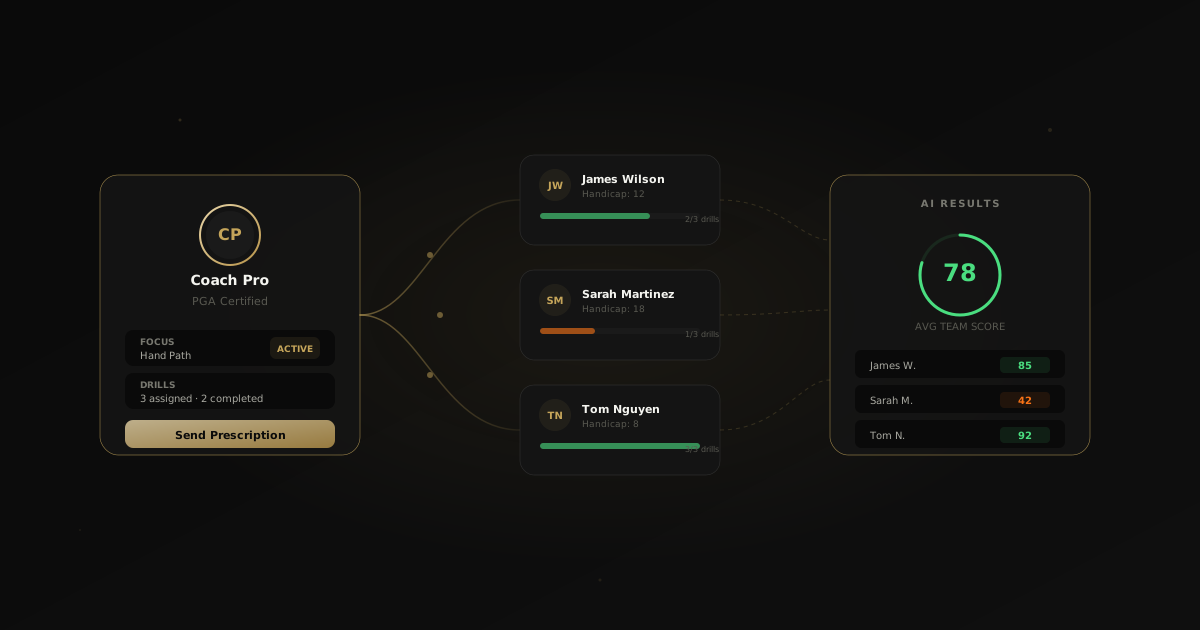
The most effective coaches don't just teach during lessons — they prescribe practice between lessons. Think of it like a doctor writing a prescription: specific drills, specific focus areas, specific camera angles, specific rep counts.
With AI-powered practice verification, you can:
- Create a prescription targeting exactly what your student needs to work on — early extension, hand path, tempo, whatever the priority is
- Let AI verify that they're actually doing the drill correctly, scoring each submission against the prescribed focus area
- Review the results with AI-generated scores, keyframe snapshots, and skeleton overlays that show exactly what happened
This creates a feedback loop that was impossible before. Your students practice with accountability. You review with efficiency. And neither of you wastes the next lesson re-diagnosing the same issue because practice went sideways.
Data You Can Actually Use
Most coaches rely on feel and experience — and that's valuable. Decades of watching swings builds pattern recognition that no algorithm can replicate. But AI gives you longitudinal data to back up your instincts and catch things the eye can miss:
- Is your student's early extension getting better or worse over time? Not based on memory — based on measured hip-to-ball distance at impact across 50 practice submissions.
- Are they maintaining spine angle through impact? The AI tracks this frame by frame and can detect 2-3 degree changes that are invisible to the naked eye at full speed.
- How does their tempo change under pressure vs. casual practice? John Novosel's Tour Tempo research identified a 3:1 backswing-to-downswing ratio among professionals. The AI measures this automatically and flags when a student's ratio drifts — often an early indicator of tension or overthinking.
- Is the kinematic sequence firing in the right order? Hips, torso, arms, club — the research from TPI shows this sequence is the single biggest differentiator between elite and amateur ball-strikers. AI can track whether your student's sequence is improving across sessions.
These aren't theoretical questions anymore. They're answered automatically with every video upload. And they give you something powerful: objective proof of progress (or regression) that you can show your student on screen.
The Strokes Gained Connection
Mark Broadie's Strokes Gained research at Columbia University gives coaches a framework for prioritizing what to work on. His data shows that the average 15-handicap loses approximately 2.5 strokes per round from tee-to-green and 1.5 from short game and putting.
When you combine Broadie's framework with AI swing data, you can make smarter coaching decisions. If a student's Strokes Gained: Approach is their biggest leak, you know to focus lessons on iron contact and distance control — not driver mechanics. The AI data on their iron swing tells you why the approach shots are costing strokes (inconsistent low point, tempo breakdown with longer clubs, etc.), and Broadie's framework tells you how much fixing it is worth.
That's the kind of data-driven coaching that was only available to tour-level instructors five years ago.
The Competitive Edge
Golf instruction is competitive. Parents are shopping for coaches. Adult learners are comparing options. The PGA of America reports over 29,000 PGA Professionals in the U.S., and that doesn't count uncertified instructors. In most metro areas, a golfer has 15-30 coaching options within a 20-minute drive.
Having AI-powered analysis as part of your offering isn't just a nice-to-have — it's a differentiator that justifies premium pricing and improves retention.
The Pitch That Wins Students
Imagine telling a prospective student: "Between our lessons, you'll upload practice videos and get instant AI feedback on the specific drills I assign. I review everything before our next session, so we never waste time re-diagnosing. You'll have a dashboard showing your progress over time — real numbers, not guesses."
That's a fundamentally different value proposition than "come see me once a month for an hour." It turns a transactional lesson model into an ongoing coaching relationship. And the data from fitness and health coaching apps shows that ongoing relationships have 3-5x higher lifetime value per client than one-off sessions.
Retention and Revenue Math
The average golf lesson costs $75-150. Most students take 4-8 lessons before dropping off — either because they don't see progress fast enough or because life gets in the way. That's $300-1,200 per student lifetime value.
A coach using AI-powered practice verification keeps students engaged between lessons, shows measurable progress, and creates accountability that prevents drop-off. If that extends the average student relationship from 6 lessons to 15-20, the revenue impact is significant — and the student actually gets better, which drives referrals.
What AI Can't Do (And Why Coaches Still Matter)
Let's be honest about the limitations. AI can't:
- Read a student's emotional state and adjust the lesson in real time
- Feel the difference between tension and proper muscle engagement
- Understand context — a student going through a divorce who needs golf to be fun, not a project
- Make creative swing decisions about when to work with a flaw vs. eliminate it
- Build the trust that keeps a student coming back
The best coaches do all of this intuitively. AI handles the repetitive, measurable, scalable parts — video analysis, metric tracking, progress monitoring, practice accountability — so the coach can focus on the high-value human parts that actually make the difference.
The coaches who thrive in 2026 and beyond won't be the ones who resist technology. They'll be the ones who use it to scale their expertise without diluting it.
Getting Started
Stroke Gained is designed for coaches. You bring your expertise, your eye, and your students. The platform handles the AI engine, video analysis, practice verification, and progress tracking.
The setup is simple:
- Create prescriptions for each student with specific drills and focus areas
- Students record practice videos on their phone and submit through the app
- AI scores each submission and flags anything that needs your attention
- You review the queue, add feedback, approve or request resubmits
- Both you and your student see progress data over time
No expensive hardware. No studio setup. Just a phone camera, a decent angle, and the coaching framework you already use — now with AI verification backing it up.
The future of coaching isn't AI vs. human. It's AI-powered humans delivering better results at scale.
Learn more about how the technology works: How AI Swing Analysis Actually Works
See the practice system in action: The Complete Guide to Practice Verification
Stay in the loop: Sign up for early access to the full Stroke Gained platform.
Written by Stroke Gained Team
The Stroke Gained team combines data science, golf instruction research, and AI to help golfers make smarter equipment and practice decisions.
Refine Your Game
Join golfers getting weekly data-backed insights.
No spam. Only gains.